Landing Lights Wetlands Saltmarsh

Updated: Sep 5, 2025
Prologue: Threaded Into the Weather
The rain stopped like a door closing softly. No final crescendo, no cinematic break in the clouds — just absence, all at once. The kind of stillness that makes you realise how long you’ve been holding something. I stood in the kitchen that morning — my kitchen now — and listened to the silence between the fridge hum and the breath of the sea, muffled and soft beyond the back dunes.
The house was no longer unfamiliar. The spoons had found their drawer. The towels knew their rails. I had even started to forget where the boxes had been. It should have felt like arrival — and maybe, in some measured way, it did — but there was something else, too. A hollowing quiet. As if all the motion that had carried me to this point had been a thread pulled taut, and now, slackened, I didn’t quite know what to do with my hands.

Somewhere in that quiet, a duck had been seen. Pink-eared Duck, the observation had noted. Two days ago. Before the weather turned and turned and turned again. The storm had gone on for days, sheeting down in long diagonal lines, the kind of rain that doesn’t just soak a place but unmake it. I imagined the wetlands swelling past their edges, imagined the duck — small, absurd, and perfectly real — lifted by wind or wing or fear, carried somewhere else. I told myself not to expect it. Not after all that water. Not after all that time.
Still, the memory of that bird persisted, floating just beneath thought like a ribbon in water.
The sky, when it cleared, looked almost embarrassed by its own excess. As if it had spent itself fully and now stood rinsed and limp — a towel wrung of weather. There was no drama in the clearing, only the silence that follows effort. The air smelled of soil and salt and something opened. I hadn’t realised how long it had been since I’d breathed without bracing.
I had never seen a Pink-eared Duck before. Only pictures — flattened, unconvincing things — where its name seemed a misdirection, the pink barely visible, the shape too odd to feel real. But something about that faint, circular mark behind the eye intrigued me. A perfect little blush of pigment, right at the crown — like a bullseye, almost. I didn’t want to think of it that way, but I did. A mark that made the bird both singular and terribly easy to imagine in a scope. That contradiction stayed with me: how something so small, so specific, could be both beautiful and exposed in the same breath.

I didn’t need to go. There were metaphorical curtains to hem, and the first groceries to properly plan. But that morning I stood in the doorway with the wind brushing the hem of my sleeves and the quiet reaching into me — and I felt the thread again. That old, invisible one. The one that tugs softly, with neither demand nor explanation, only a suggestion that something is waiting.
There is a kind of yearning that belongs to no one. It moves through us the way rain moves through reedbeds, silent until it leaves something brighter behind. I felt it then — not as urgency, but as invitation. A spool unrolling. A feather drifting, mid-air, as if choosing where to land.
So I did not deliberate. I only listened. And when the thread pulled, I followed.
i - Transit, Tourists, Teals
It wasn’t exactly about the Pink-eared Duck. Not at first. Not in the serious, target-driven way birders sometimes speak about “ticking” a species, as though intimacy could be achieved by proximity alone. My interest was vague — almost ceremonial. I had seen the sighting and folded it into my week like a thread slipped between stitches. A maybe. A soft magnetism.
But getting to Landing Lights was more ordeal than pilgrimage. It’s tucked into a strange, interstitial edge of the city — just outside the perimeter of the airport, where the planes tilt like metal birds too large for the sky. There is no easy entrance. No parking lot or signboard. Just a slipstream of commuters and tourists dodging the twenty-dollar airport train fare by swarming the local bus. They spilled out at the same stop as me — frantic, sunburned, dragging wheeled bags across cracked pavement.
A child sat on the sidewalk and began clipping his fingernails. One by one. Dry, crescent shards pinging against the concrete, small and abject. With each click, a wave of nausea rose up in me. There are things that feel wrong in a way you can’t articulate — not dramatic, not urgent, just off. It was as though the day itself was trying to dissuade me.
By the time I found the path into the saltmarsh, I felt absurdly relieved — not for having arrived at the bird site, but for simply being away from people. The path wasn’t a path, not really. More a suggestion — edges blurred by overgrowth and disuse. The boardwalk, where it existed at all, had been reduced to a soft crumble of wood. It fizzled beneath my feet, less structure than memory.
Skinks darted from every step, tiny lives skittering through grass. I let them startle me. I welcomed it. And then — in the middle of the pond — I saw them.

Chestnut Teals, mostly. Still, preening, or drowsy. But behind a low green bush, partially obscured, was a duck unlike the others. Smaller, sleeker, its plumage threaded with stripes, like the contour lines of a buried map. I couldn’t be sure — not from that distance, not with its head tucked just so — but the thought was immediate, like a bell rung in the body: it might be the one.
It refused to budge. And I did not move closer. I stood, ankle-deep in uncertain grass, watching the duck through branches and blur, letting the possibility spool out inside me — not certainty, but proximity to it.
ii — Where Hesitation Becomes Invitation
The boardwalk — what was left of it — curled further into the wetland like a thought half-remembered. Each plank softened at the edges, blunted by weather and time. Small birds danced at every step. Red-browed Finches flitted in brief, jewel-toned flashes; a White-browed Scrubwren cast me a look of mild disapproval before hopping theatrically out of reach. The path led to the end of the pond’s open view, and beyond it, the soundscape shifted.

A new voice filled the reeds: the unmistakable call-and-response of Red-whiskered Bulbuls. They were everywhere, hidden and not, their melodies fluttering through the air like tossed ribbons. There was something joyful in their presence — chaotic, ornamental — as though they’d been assigned to decorate the moment.
I moved cautiously into a narrow corridor of flattened reed, clearly pressed down by others before me, all hoping for a better view of the pond. The clearing was just wide enough for one body, and I stood there without moving further, unwilling to step on what had not already been trodden. My boots stayed still, half-submerged in the idea of permission. And that — strangely, precisely — is when it happened.
A flicker. A sound.
A small bird emerged — low to the ground, agile, threaded in sun.
A Golden-headed Cisticola.

I had seen the name in observations so many times, skimming past it with a casual reverence. But here it was, utterly alive. Bubbly, bright-eyed, with the punkish energy of something that had never once worried about how it was perceived. It danced in front of me, sang once — briefly, gorgeously — then pivoted with theatrical flair and vanished again, off to deliver its next performance to some other lucky passer-by.
It was a lifer. And not just in the sense of new species added to list, but in the way something small folds itself perfectly into the moment you didn’t know you needed. It had found me precisely because I’d stayed still. Because I’d chosen not to break anything to get closer.
It sang, I clicked. It vanished, I stayed.
The whole encounter couldn’t have lasted more than sixty seconds. But the memory already exceeds its footprint. I didn’t just see it — it chose to let itself be seen.
iii — Where the Path Ends, Something Sings
I followed the same trodden path where the cisticola had dazzled and disappeared, hoping the marsh had one more secret to offer. It was brighter now — the kind of Sydney morning where light feels like it’s been scrubbed clean by rain. A Superb Fairywren bounced into view, its tail vertical and defiant. But as I rounded the bend, the way forward dissolved. The week’s worth of rain had gathered in the low-lying curve of the track, and the result was clear: full flooding, no hope of passage.
The water lapped gently against the reeds, sun glinting across its surface as if to mock me. My shoes — once white, now more of a guilt-stained beige — had only just recovered from their last indignity. I looked at the water. I looked at my shoes. I thought of my washing machine, and all it had suffered.
I laughed. Out loud. I wasn’t going in.
And then — as if to reward my restraint, or maybe just to fill the moment with punctuation — a Red-whiskered Bulbul emerged. Not flitting through foliage or hiding in song, but perched. Proud. Singing just for me.
Its crest, always a little theatrical, looked particularly mischievous — two little tufts rising like cat ears. It sat there with complete confidence, as if it had been cast in this scene long ago and had just been waiting for its cue. I raised my camera and hit record. It stayed.
The bulbul’s song was fluttery, multi-syllabic, like someone practicing a language no one else spoke but them. It wasn’t the rarest bird of the morning, not even close. But it was the most generous.
I turned back then, toward the crumbling boardwalk, toward the pond and the duck I still hadn’t confirmed. But before I reached it — just before the wood reappeared beneath my feet — the sky changed.
A hush swept through the saltmarsh like a hand brushing across fabric. The chatter of honeyeaters, the whip-crack calls of lapwings, even the constant flutter of unseen wings — all of it stilled. The silence was immediate, instinctive. Above me, circling slow and wide, was the unmistakable shape of a raptor.
An osprey.
It turned with that impossible stillness only birds of prey possess — as if the sky were water and it simply knew how to float. It looked down. It looked through.
And then it dropped — out of view, swift and terrible.
I never saw what it struck. I never heard the impact. But the marsh seemed to know. The moment folded in on itself, music cut mid-note. The curtain fell.
Tragedy. That must be the play.
iv — To Travel With, But Not Among
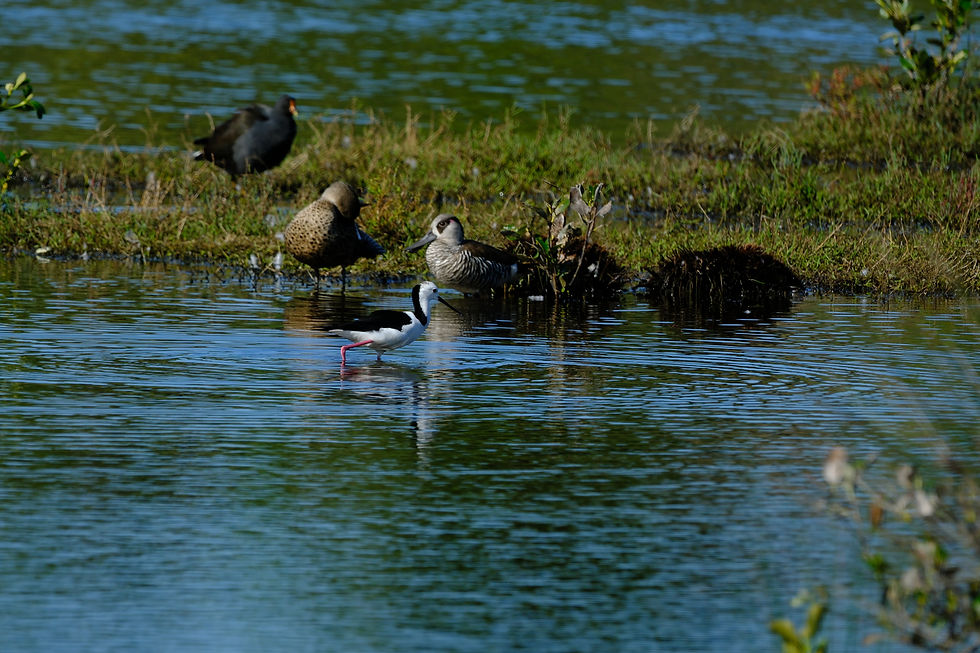
And then — as though the marsh had been waiting for the right pause in the day’s theatre — the Pied Stilts arrived. They did not land so much as settle, graceful as an intake of breath. Their black-and-white silhouettes stitched themselves into the water’s edge, legs like calligraphy, trailing behind them. There was no flourish, no urgency. They simply appeared, and in doing so, made the pond new again.
Their presence revealed what the morning had obscured — that the pond was, in fact, incredibly shallow. The rain that had flooded the path had only brushed the surface here. The water’s illusion of depth was just that — an illusion. A mirror stretched thin across reluctant soil. And yet, life moved through it as though it were enough. It wasn’t abundance that defined this place. It was accommodation. Adjustment. The choreography of survival.

The Chestnut Teals had vanished earlier, but the stilts carried the silence with grace. They waded without fanfare, and the only other life visible was a ragged little cluster of Dusky Moorhens skulking along the far edge, looking — for all the world — like they’d just committed a minor crime and were pretending it hadn’t happened.
I stood still. The sun had begun to swelter, slow and deliberate. Light shimmered on the water, dazzling in small, insistent ways. I watched the stilts pick their way across the shallows, drawing invisible lines with every step. I tried to trace their paths in my mind, but they never overlapped. They knew how not to disturb each other.
And then — a rush. A blur of wingbeats and urgent precision.
The teals had returned. All at once. As though summoned, as though drawn back by some invisible pulse. They swept low across the pond, curved, landed — the water dimpling in applause. And just like before, in the same green-cloaked corner of the pond, a single duck revealed itself. Or rather, didn’t.
The same bush. The same impossible angle. But this time, closer. And I was certain.
There it was: the Pink-eared Duck. The goal, the maybe, the thread that had pulled me all the way from my quiet kitchen by the sea. It had hidden all morning, placing itself just outside reach like a well-written line at the end of a letter. It knew. I was sure of it. There was a theatricality to the way it moved — always half-visible, always in profile, as if withholding something on purpose. A performer who understood that the best way to hold an audience is to delay the reveal.
I resolved to wait. Observation Record-Field Notes:
Species: Pink-eared Duck (Malacorhynchus membranaceus)
Date: 24 May 2025
Time:
Location: Landing Lights Wetland, Kogarah, NSW, Australia
Coordinates:
Habitat: Shallow ephemeral pond within urban saltmarsh corridor. Vegetation overgrown; path unmarked and partially submerged due to prior rainfall. Duck observed in reed-edged central water body, partially concealed behind low green shrub near cluster of Chestnut Teals. Water depth minimal, indicating pond’s limited capacity.
Behaviour: Initially partially obscured; positioned low and motionless behind vegetation, head tucked intermittently. Showed avoidance or passivity rather than alertness. After prolonged absence, returned with teal group, landing in unison. Remained closely associated with Chestnut Teals throughout. Maintained proximity to cover even in open water. No vocalisation noted. Plumage distinct; black-and-white facial barring, pale flank striping, pink auricular spot visible intermittently. Bill wide, paddle-shaped — noted foraging motion absent during observation.
Weather Conditions: Post-rain humidity. Mid-morning heat rising. Path flooding suggests recent heavy rainfall; ambient temperature increasing during observation. Still air; minimal wind. Light reflected across shallow pond surface. High sun exposure at time of confirmation.
Observer: Najika
And in that waiting, the moment opened.
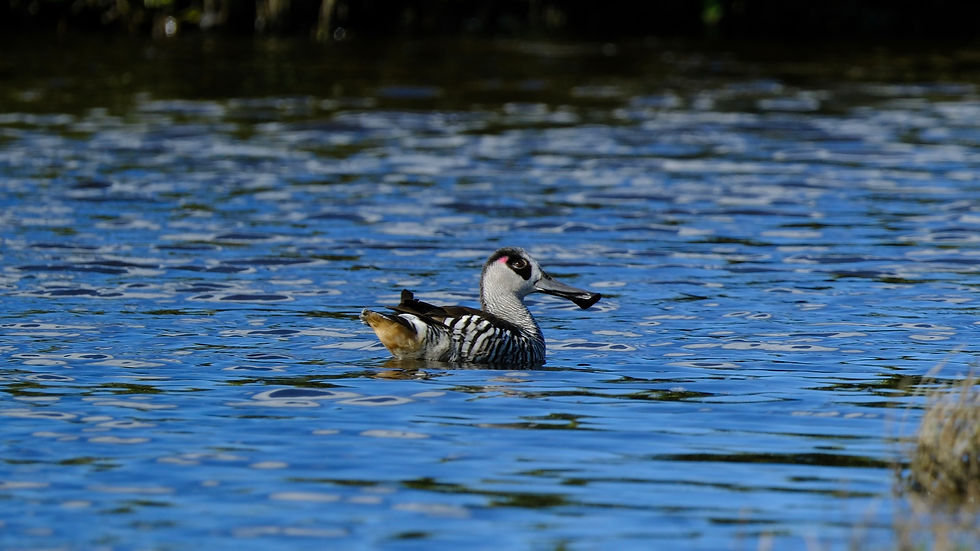
It stepped into full view at last — not with drama, but with quiet inevitability. Its zebra-striped plumage caught the light in a way that felt composed. The wide, odd bill gave it a look of permanent curiosity. It was beautiful — unmistakably so — but not in the clean, effortless way that some birds are. Its beauty was patterned, deliberate, earned.
It nestled close to the teals, moving with them, mimicking their rhythm. Part of the flock, but never fully of it. And there — right there — something in me caught.
To be the only one of your kind. To travel with others who will never quite mirror you. To wear your difference plainly, on your skin, your face. It looked so lonely. Not in the pathetic sense — not diminished — but in the way something can be radiant and still apart. As if it had carved out a life beside belonging.
I watched it move. I watched it rest. I felt something fold open in my chest. Not triumph. Not even satisfaction. Just a quiet, devastating recognition.
I had come chasing a duck. I left knowing I had been seen, too.

v — The Duck, and the Witnesses
I wasn’t the only one who had come for it.
Later — after the light had shifted into that late-morning haze and the duck had settled again into its shadowed cove — a pair of birders arrived. Quiet, efficient, deeply familiar with the choreography of searching. Both carried binoculars, held up with the kind of reverence reserved for ritual. I recognised the expressions immediately — hope disguised as calm. They were here for the same reason I was.
We exchanged a few words, soft and sparse. The kind of field conversation built entirely on mutual understanding. I offered the direction, the angle. They nodded, and looked. One of them whispered — “There.” The other exhaled.
There’s something deeply human in that moment — when a species becomes not just a tick or a goal, but a brief communion between strangers. We had all been drawn here by the same thread: the promise of a duck with a face like a fingerprint, a bill like a ladle, and that impossible pink spot behind its eye.
Malacorhynchus membranaceus. The name is heavier than the bird. Despite its oddity — or perhaps because of it — the Pink-eared Duck is remarkably successful. It isn’t rare, but it feels rare. Partly because it moves like a ghost: highly nomadic, appearing where the water appears, gone again with the same ease. It doesn’t belong to any one place, not even to wetlands like this. It follows flood. It follows opportunity. It adapts.

They feed by spinning — often in pairs — whirling tight circles in the water to draw plankton to the surface. When they do this in synchrony, they look like something out of a folktale, a mechanical toy set loose in a mirror-world.
This one did not spin. It stayed still. But it stayed here, and that was enough.
The other birders lingered. One of them managed a photo with their phone, the other simply watched. I didn’t ask if it was a lifer for them too. It didn’t matter. What mattered was that we had seen it. Not just the bird, but each other — quiet, precise, entirely present.
We stood there together, each at the end of our own thread, watching the same beautiful, peculiar centre.
Epilogue:
By the time I left, the sun was high and unforgiving. Noon light pressed down without subtlety — no haze, no shadowplay. Just everything laid bare. The pond shimmered not with mystery, but with exposure. The boardwalk beneath me had warmed, softened. It felt like walking across old bones.
The duck had tucked itself away again. Vanished into the reeds like the idea it had always been — elusive, probable, finally proven. There was no grand finale. No final look. Just a quiet, almost polite withdrawal.
I lingered, not because I hoped for more, but because leaving felt abrupt. The kind of moment that should end with a bow or a closing line, but doesn’t. The others — the birders — had already gone. The birds had resumed their motions. The saltmarsh returned to its soft unravel.
It struck me then that the duck had never really belonged to the marsh. Not in the way teals do, or moorhens, or the bulbuls flinging themselves into every inch of the air. The Pink-eared Duck is a visitor — a nomad that answers only to the shape of water. It is not loyal. It appears where the conditions are right, and it stays until they are not.
And yet it had been here.
And I had been here.
That’s what stays with me. Not the bird, exactly, but the conditions that allowed it. The silence of others watching. The restraint of not stepping on reeds. The sharp pink behind the eye. The pond that was barely holding together. The way even that — shallow, crumbling — had been enough.
On the way back, I passed the fingernail clippings again. Still there, scattered like brittle secrets the path had no choice but to keep. And I didn’t flinch this time. They had become part of the place, absurd and immutable. I had come looking for a duck. I left with a whole ecology of feeling.
Some things don’t ask to be witnessed. But when you do — when you wait — they let you see them anyway.
And isn’t that everything? Birds Seen at Landing Light Wetland – 24th May 2025
A non-exhaustive list of companions, glimpsed and remembered:
• Pink-eared Duck (Malacorhynchus membranaceus) — 1, striped and singular, reclusive behind green
• Chestnut Teal (Anas castanea) — ~8–, steady companions, loosely gathered
• Pied Stilt (Himantopus leucocephalus) — ~10–15, arrived together, sweeping the shallows
• Golden-headed Cisticola (Cisticola exilis) — 1, lifer, bold and bubbling with song
• Red-whiskered Bulbul (Pycnonotus jocosus) — numerous, theatrical, in tree and air
• Dusky Moorhen (Gallinula tenebrosa) — 4–6, skulking at pond edge, evasive
• Superb Fairywren (Malurus cyaneus) — scattered, flaring blue against reeds
• Red-browed Finch (Neochmia temporalis) — ~10+, skimming low, seed-seekers
• White-browed Scrubwren (Sericornis frontalis) — 2–3, brisk and disapproving
• Eastern Osprey (Pandion cristatus) — 1, high and circling, silencing the marsh with its shadow


