Oatley Park & Lime Kiln Bay

Updated: Sep 5, 2025
Prologue: The Ones Who Visit
I didn’t come for anything in particular. A Boobook, maybe. A Robin. But really, I came because something was happening here—something that moved, and shifted, and asked to be noticed without being interrupted.
The birds migrate. So do the tides. The flowers come into bloom, then vanish. People walk these paths, then leave no trace. I came too, not to stay, but to learn—how to be still without expecting stillness, how to observe without demanding meaning.
Over time, the place began to speak—not in facts, but in rhythms. I noticed the way the light filtered through eucalyptus at noon, how the reeds bowed in wind but never broke, how the sound of wings overhead made me pause without thinking.
Nothing waited for me. Nothing stayed because I was there. And somehow, that made it feel more alive.
Everything here is in motion. Including me.

I - An Invitation
A study in ethical birding
I was invited to Oatley by a local birder—someone who doesn’t just know the trails, but moves through them like breath through a reed. Each turn was taken not with hesitation, but with a rhythm born of repetition, of love, of return. She named trees with familiarity, greeted birds with the gentle authority of someone who has seen them moult, nest, vanish, return. There was no searching, only recognising.
To walk beside someone like that was to be reminded of what it means to belong to a place—not in name, but in bone. She knew the forest like a pantry of small wonders, each drawer a habitat, each shelf a thicket. The termite mound tucked behind the bend where kingfishers tunnel in spring. The trail where, come April, the rose robins slip quietly through, heading north for winter. Her world was annotated with memory. Mine was still blank.
And I envied it—not the knowledge, though that too—but the intimacy. The rootedness. The idea that a landscape could know you back.
I have never lived like that. Never stayed long enough. My life is a series of arrivals and departures, of field guides half-scribbled and birds seen only once. I’ve spoken in too many tongues to belong to any one of them—balancing so many songs that my own voice has always felt borrowed, never native. I’ve been passing through for so long, I’ve forgotten what it means to remain. To root. To hum a note back to the forest and believe it knows your name.
And yet, there was something in that walk—beneath the low branches, through the salt-pricked air of the mangroves—that made me ache not just to see, but to settle. To find a patch and learn it the way you learn someone you love: slowly, reverently, without the need to rush.
For a moment, I was not just visiting a park—I was visiting a possibility.

It’s a gift to bird with someone like that, someone who doesn’t just show you birds, but place. Not just wings—but how the light moves through the mangroves.
And what mangroves.
II - The Mangrove Mood
Trudging amongst the rain that floods the basin
Tide high and whispering out. Then low again, peeling back the slick banks to reveal a world of soft-footed movement. Ibis stepping deliberately across the mud. In the hush of the mangroves, three Royal Spoonbills stood poised like sculptures of light, their plumage catching flecks of sun that had filtered through the canopy above. They moved with a kind of reverent slowness, sweeping their broad, spatulate bills side to side in the shallows—each motion an act of intention, of ritual.

Trailing just behind them, almost sheepishly, a Little Egret kept pace—its narrow form darting in and out of the spoonbills’ wake, eyes sharp for whatever stirrings might be flushed into reach. There was no malice, just strategy. Let the giants do the stirring; the egret would collect the crumbs.
Nearby, a White-faced Heron stood apart, motionless, neck curved in an alert half-loop. It didn’t need the crowd. It watched. It waited. It knew something would move.
And when it did—some unseen flicker beneath the water—it struck, fast and clean. Then stillness again, as if the strike had never happened. A bird built not for show, but for certainty.
“The real voyage of discovery consists not in seeking new landscapes, but in having new eyes.” - Marcel Proust
III – The Forest Threads

In the thicker bushland, things changed. Denser. Quieter, then suddenly full. A flock—no, a swarm—of Yellow-faced Honeyeaters, sixty or more, turning the air electric. Fantails darted between trunks like tiny cogs in an invisible machine, and from somewhere overhead came the sudden echoing call of a Golden Whistler—then two. Males, both impossibly bright, weaving between trees like spools of living thread. One flew so close I felt the breeze of its passing.
But I had come for something else.
The Rose Robins had been sighted recently—small, shy, and in that brief slant of late-morning light, heartbreakingly beautiful. The male with his pink chest, like a petal folded in the middle of winter. The female, subtler, mistier, as though brushed in dusk.
They were there.

Moving gently through the understorey, flitting in and out of reach. I stood still and watched until I forgot I was watching. The grey fantails danced around them like sparks.
We spotted the male first, impossibly small, impossibly pink—like a fallen petal that had grown wings. He flitted across the shaded understory in sudden, bright darts, always a few beats ahead of our eyes.

He paused once—just long enough to face us directly, throat rising and falling with the breath of effort or instinct. A flash of rosé against the dark.
The female was quieter, greyer, but no less lovely. She moved with the ease of someone who knows she doesn’t have to prove anything to be worth watching.
Observation Record-Field Notes:
Species: Rose Robin (Petroica rosea)
Date: 18th April 2025 Time: 2:28 PM Location: Oatley Park, NSW
Coordinates: -33.9778, 151.0608
Habitat: Dense valley woodland, littered with sheoaks and coast banksias; midstorey well-shaded
Behaviour: Flying from low perches; frequent returns to same branch, drooping wings
Weather Conditions: Overcast, 15.8°C - 22.5°C Observer: Najika
What struck me most about the Rose Robins, beyond the blush of their colour, was the way they seemed to live between heartbeats. The male, vivid as a dropped petal; the female, duskier, more reticent. But both carried that same hush of tension—their wings not folded tight, but drooped, slightly, as though always walking a thread drawn taut between two trees. A balancing act so understated you could miss it if you weren’t quiet inside yourself.
They perched low, favouring the thinner branches, where the breeze spoke louder and the margin for error was smaller. And there they would remain—hovering, not in air, but in intention. In the pause before movement. In the inhale before song. It was a posture that felt less like stillness and more like listening with the whole body.
It wasn’t fragility. It was precision. A way of being in the world that held everything lightly but deliberately. A way of moving through the world that made every moment feel tentative and exact.
I had been carrying a small hope for Rose Robins for some time. Not a checklist hope, not a twitcher’s tally—something gentler. More like a thread I’d been following for years. I’ve seen photos of the Pink Robin, its impossible flush of colour like a flame in mist—but they’re secretive, mostly Tasmanian, and wander north only rarely, briefly, into the highlands. Sydney hardly holds them.

But Rose Robins—closer kin, still elusive—felt like the ghost of that wish, made slightly more real. They arrive in winter, slipping quietly into denser gullies and shaded woodlands. I’d scanned many forests for that flash of dusky blush, always just missing it. A bird not rare in numbers, but rare in timing. Rare in permission.
To finally see them—two, no less, one bright and one barely blooming—felt like a wish not granted but answered gently. Not shouted into being, but whispered back. As if the forest had noticed the weight I carried, and decided, just once, to set it down beside me in feathers.
IV - The Encounter, Interrupted
The Olive-backed Oriole
The Olive-backed Oriole is a bird made mostly of distance: elusive, seldom seen, more voice than form. I hadn’t encountered one in a year, and here, there were two. For a while, they kept their altitude, slipping between boughs like thoughts not quite formed. But something pulled one lower—curious, deliberate, as if descending through layers of sleep into something waking and sharp.

Below, the male Rose Robin was still tracing light into the understory, a fragment of spring mistaken into winter. His presence felt sacred—fragile in that way only beauty can be when it forgets to guard itself.
The oriole cut through that moment like a comet—fast, silent, sure.
Not quite an attack. More a gesture. A warning dressed in flight. Its body dipped, tilted, the air tightened—and the robin fled, his pink flame snuffed in the foliage.
And just like that, the magic fractured.
The oriole climbed back into the green hush above, red eye catching what little light remained, expressionless as a coin. Below, the absence of the robin lingered like a bruise on the page.
What had been wonder became rule. Territory. Gravity.
This is what the wild does when it speaks plainly.
It reminds you: the forest is not yours. Awe has teeth.
I lingered.
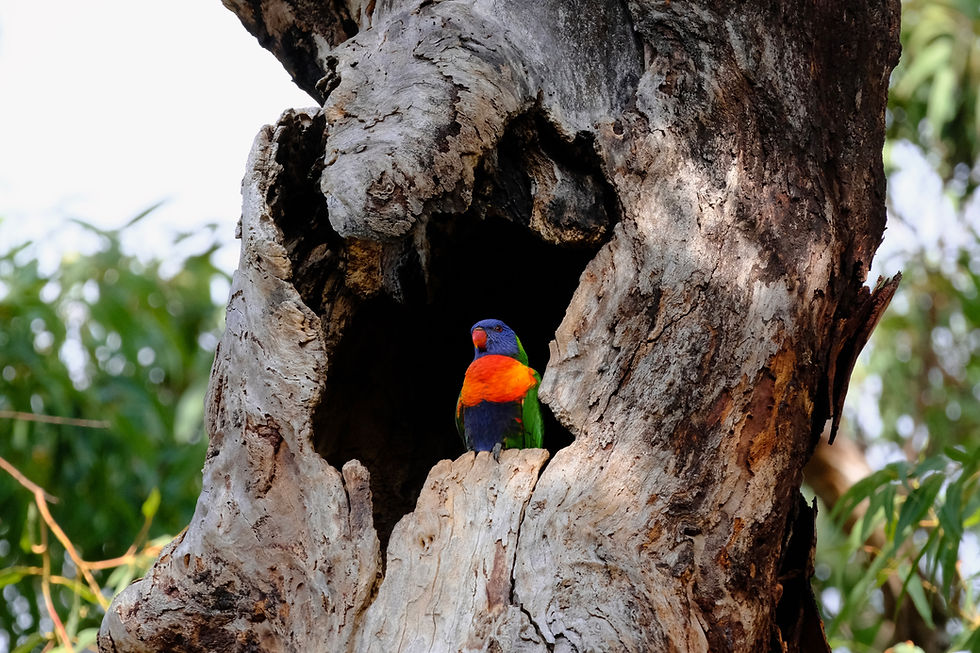
Not for more sightings, not for the list, but because the light had changed, and so had I. There were other birds still. The Grebe on the pond, self-contained and serene. Dusky Moorhens skimming the margins. A brief chatter of lorikeets overhead.
V – The Silence that Follows
What stirs within the hollows
But the day had begun to fold inwards. The trails grew quieter. Shadows softened the undergrowth.
And deeper in, beneath the hush of overgrown casuarinas, the forest gave one last gift.
Past the banks and under the quieter trees—there was the Boobook.
I won’t describe the exact spot. Some birds deserve to stay unmentioned. Not because they are secrets—but because they are sacred. It was still. Tucked in. Not hidden, but cloaked in the quiet authority of something that simply belongs.
It looked at me. I looked back.
That was enough.
Some birds you celebrate by sharing. Others you honour by letting them stay exactly where they are.

Epilogue: The Leaving Was Quiet
By the time I turned to go, the robins were gone. Or maybe they’d simply grown quiet.
The saltmarsh didn’t ask me to stay. The trees didn’t offer closure. Nothing waved goodbye—not even the wind.
And yet, something lingered. Not the birds themselves, but the shape their presence left behind. The hush between wingbeats. The shimmer of having just missed something, or maybe having arrived exactly when I was meant to.
They were passing through. So was I. But we were here, together, long enough for that to mean something.
And when I stepped off the trail, it felt less like leaving and more like being gently let go.
Birds Seen at Oatley – 18th April 2025 & 23rd April 2025 & 25th April 2025
A non-exhaustive list of companions, glimpsed and remembered:
• Rose Robin (Petroica rosea) — 2 male, 3 female • Golden Whistler (Pachycephala pectoralis) — 2 males, weaving song into sunlight
• Yellow-faced Honeyeater (Caligavis chrysops) — ~60, in restless, electric flocks • Brown Thornbill (Acanthiza pusilla) — ~25, busy in the undergrowth • Grey Fantail (Rhipidura albiscapa) — numerous, tireless, everywhere • Silvereye (Zosterops lateralis) — ~5–7, flitting in sharp little groups • Superb Fairywren (Malurus cyaneus) — scattered, blue sparks
• Olive-backed Oriole (Oriolus sagittatus) — 2, assertive and bright-throated • King Parrot (Alisterus scapularis) — 2, bold and radiant • Crimson Rosella (Platycercus elegans) — ~3–5, flashes of scarlet
• Royal Spoonbill (Platalea regia) — 3, sweeping the mangrove shallows • Little Egret (Egretta garzetta) — 1, trailing in quiet strategy
• White-faced Heron (Egretta novaehollandiae) — 1, poised and precise
• Australasian Grebe (Tachybaptus novaehollandiae) — solitary, drifting pond-centre
• Australian Boobook (Ninox boobook) — 1, sacred, still
In the end, I didn’t take much home. Just the memory of having been there, and the promise to return with gentler steps.
“To pay attention, this is our endless and proper work.” - Mary Oliver

